
Online Banking: Everything You Need to Know About
 Previous
Key Takeaways:
Thanks to online banking, businesses can manage direct transactions, pay bills, and automate operations remotely, all from a single platform 24/7.
Strong security features, such as two-factor authentication (2FA) and encryption, help prevent fraud.
Lower fees and faster processing improve efficiency and reduce overhead.
Platforms like Bivial offer API integrations and global payment capabilities.
Recent global research by Finastra shows that 99% of financial institutions now view open banking, or online banking, as “important” or a “must-have” for their business. The industry’s growing focus on automation and instant digital services reflects what modern companies now expect from their banking partners.
In this article, we’ll cover what online banking is, how it works, and the advantages it offers to organisations looking to expand internationally.
In this article, we’ll cover what online banking is, how it works, and the advantages it offers to organisations looking to expand internationally.
What Is Online Banking?
While the meaning behind online banking may differ slightly depending on the provider, it generally refers to a flexible, digital-first system that allows registered users to access their accounts online on their desktops or mobile devices. In most cases, the features are identical on both, thus making it easier for clients to use banking services on the go or from home. There are no time limits: transactions can be conducted at any time, even at night and during holidays. If something goes wrong, the customer support team is available to assist you with any service-related queries.For those unfamiliar with how online banking works, it’s simple: users log in through a secure connection and carry out typical operations, such as transfers, account checks, and bill payments, from a unified dashboard that replaces the need for in-branch visits.
It’s important to note that traditional banks aren’t the only providers of digital banking. Many online platforms like Bivial now offer the same package of features, sometimes even with greater flexibility or lower costs.
The Difference Between Traditional, Mobile and Internet Banking
When asked this question, most answers boil down to the following:- Traditional banking happens at a branch.
- Internet banking transfers financial operations to a desktop.
- Mobile banking bids farewell to these intricacies, while bringing all services to the phone.
Traditional banking requires a physical presence indeed. Regardless of how uncomplicated your request is, you’ll need to visit a branch, and that can be time-consuming. Online banking, on the contrary, provides 24/7 access to your accounts from home, without queues or waiting. Mobile banking works similarly but via an app, which often adds tools like instant notifications or contactless payments through Apple Pay, Google Pay, QR codes, or NFC.
As the global economy becomes more interconnected, digitalisation is transforming transactional banking. Modern fintechs are now delivering faster, fully integrated solutions that meet the needs of today's online businesses. Unburdened by legacy systems, they provide capabilities often out of reach for traditional banks. Thanks to encryption and advanced fraud detection, digital banking stays a highly secure environment.
What Can You Do With Online Banking?
Online banking services encompass account management, payments and transfers, financial management tools, and more. The selection varies depending on the provider, but the core idea remains unchanged: most day-to-day financial tasks can now be completed online. Here’s what you can do.Pay Bills
Paying for services like rent, utilities, or mobile contracts has never been easier. You can add a payee once and save your card details for future recurring transactions. Another feature that can help you organise your accounts effortlessly is setting reminders that automate the process partially or entirely. Why manage invoices across different platforms when you can keep everything in one place?Make a Deposit
With virtual banking, funds can be transferred or uploaded remotely, sometimes even through mobile cheque capture. The process streamlines routine transactions and eliminates ambiguity. Once confirmed, deposits appear in your account instantly; however, please note that verification times may vary by provider.Manage Your Accounts
If keeping track of your account activity is crucial for your business, then switching to digital banking is a must. There, you can review incoming and outgoing payments, confirm money received, and spot unusual transactions the moment they happen. This visibility helps mitigate potential errors and keep your finances aligned without delay.Make Account-to-Account Transfers
Another common use of virtual banking is moving funds between accounts. As said, the process is instant and easy to track, regardless of the transaction’s nature: you can be shifting money from savings to checking or between business accounts. Transfers can be scheduled, repeated, or adjusted on demand.Check Statements and Account Balances
Many users still ask, “How do I get my bank statement online?” With most platforms, the process is straightforward: log in to your dashboard, navigate to your account overview, and download the statement in your preferred format. Online banking is transparent, and that’s the best of it. Track deposits, outgoing payments, and confirm when a bill has cleared. The available balance shows what’s actually accessible, helping you avoid overspending or delays in posting.Order Checks
This feature may sound outdated, but those engaged in the field of finance will confirm that even in a digital-first world, checks haven’t vanished entirely. Some providers still offer the option to order them online without visiting a branch or filling out forms manually. You can select a design, review costs, and submit the request directly through your dashboard. It’s an old tool, but still relevant in more traditional or document-heavy business scenarios.What Are the Benefits of Online Banking?
As presented, online banking offers clear advantages that contribute to faster decisions, lower costs, and greater control. This is particularly beneficial for businesses with global aspirations that manage multiple accounts concurrently.Convenience and Accessibility
With virtual banking, there are no restraints on time or location. You can forget about inconveniences such as adjusting your job schedule to the bank’s business hours or spending hours on physical paperwork. Issue payouts, switch between currencies, or access multi-account views—you only need a stable internet connection.Level of Security
Modern online banking platforms rely on a simple and secure login process, encrypted connections, and real-time fraud monitoring. With the proper precautions, digital banking remains protected even in the face of the latest scams. Using two-factor authentication, strong passwords, and trusted personal devices limits unauthorised access. Avoid accessing financial accounts over public Wi-Fi and always verify the legitimacy of websites or messages before entering sensitive information.Speed
Online banking eliminates the need to visit your local branch and wait in line—all financial transactions are transparent on your screen. Transferring money, paying bills, or ordering checks instantly.Lower Fees
You could save significantly on fees and earn more in interest with a digital-first provider. At the same time, digital banks often eliminate monthly maintenance or minimum balance fees.How to Keep Online Banking Information Safe
Security in virtual banking relies not just on infrastructure but on user behaviour. Understanding common risks and applying practical safeguards reduces the chance of breach, fraud, or data loss across personal and business accounts.Use a Strong Password
Weak or recycled passwords are among the most frequently exploited vectors in account breaches. Passwords should be at least 12 characters and include a combination of randomised uppercase and lowercase letters, numbers, and symbols. Avoid mentioning personal data, common dictionary words, and predictable patterns. Where possible, opt for complex passphrases or strings generated by password managers.Use Two-Factor Authentication
According to Microsoft, enabling 2FA blocks over 99% of automated attacks. Even if login credentials are compromised, 2FA mitigates unauthorised access by requiring an additional factor: typically a time-sensitive code, biometric input, or hardware token.Monitor Your Accounts Regularly
Reviewing your account activity frequently helps notice suspicious transactions, reconcile discrepancies, and respond to threats before the financial impact escalates. Although the majority of digital platforms now notify users promptly if potential risks arise, manual review remains crucial. And if the account belongs to multiple users, double-checking is an unconditional necessity.Be Wary of Phishing Scams
Phishing attacks often rely on impersonation. They hide under the disguise of trusted providers or internal contacts to further extract login details or payment authorisations. To protect your online banking account from them, here’s what you can do:- Avoid clicking on unsolicited links.
- Verify sender addresses carefully.
- Never enter credentials via embedded forms or unsecured portals.
Setting up Online Banking
Getting started
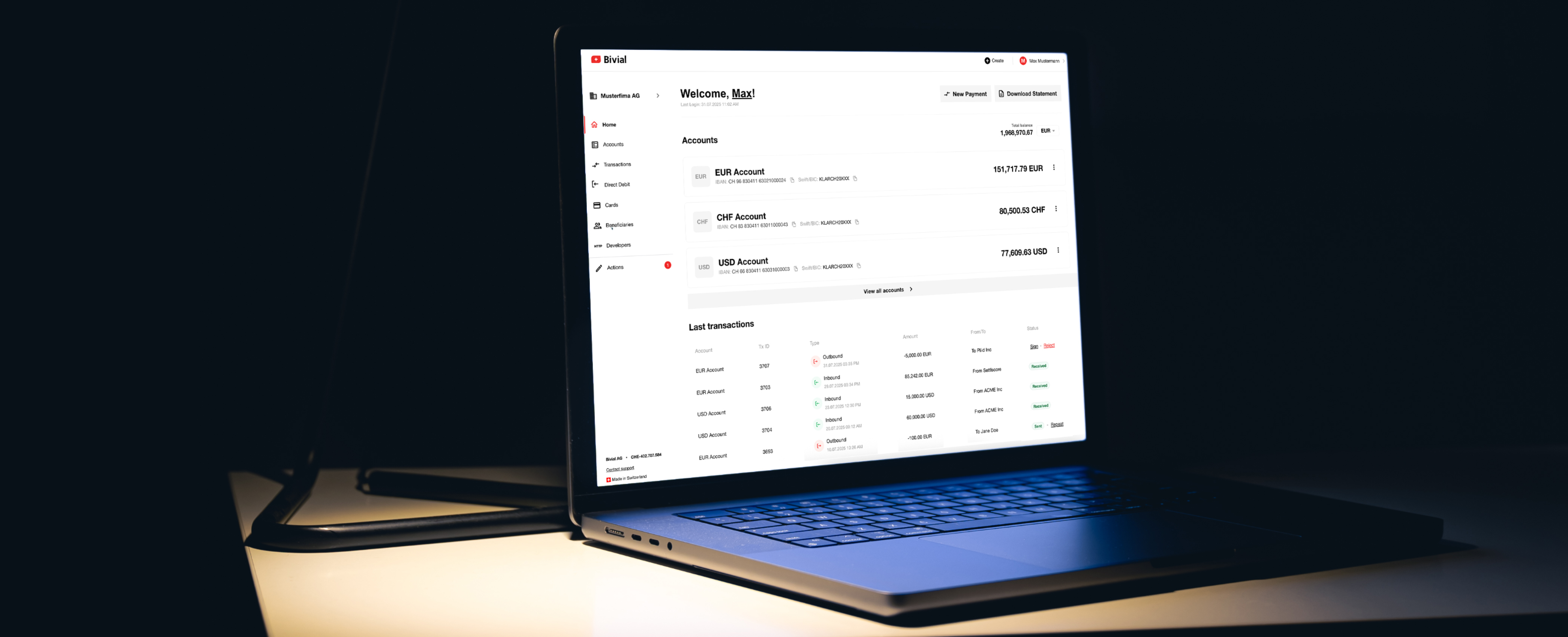
Setting up virtual banking with Bivial begins with remote onboarding and ID verification. The process is fully digital and requires no physical visits. Once approved, clients receive secure access to Bivial’s Dashboard, where they can configure accounts, permissions, and reporting preferences.Bivial online account for businesses
Bivial Business Accounts are designed for global companies managing online payments, user access, and reconciliation across multiple entities.- Comprehensive dashboard. Multiple companies, user permissions, signatories, and products can be managed in one place.
- Swiss safeguards. Swiss IBAN accounts are available in multiple currencies, with transparent exchange rates.
- Global payment capabilities. Payments and collections are enabled across borders, allowing businesses to send and receive funds according to customer preference.